
Custom Sports Courts in Holbrook, NY: Choosing the Court, the Striping, and the Surface

For a family that plays outside, custom sports courts in Holbrook, NY turn an underused corner of the yard into the place everyone gathers after school and on weekends.
The hard part is not deciding that you want a court, but deciding which court, which surface, and how it should fit the rest of the property. This guide walks through the choices that shape a custom court, the games it serves and the ground it sits on. It is written for homeowners planning a court they will use for years, not for a quick weekend build.
What began in 1976 as one man's commitment to quality and honesty has grown into a family legacy. Across five decades on Long Island, our family has designed and built outdoor spaces that hold up to real use and still look considered.
A sports court is one of those spaces where design and construction have to work together. Getting the choices right up front is what makes a court a joy rather than a regret.
What Are Custom Sports Courts, and What Can Go on One in Holbrook, NY?
Custom sports courts are private recreation surfaces designed for a specific family and a specific yard, rather than a standard rectangle dropped on the lawn.
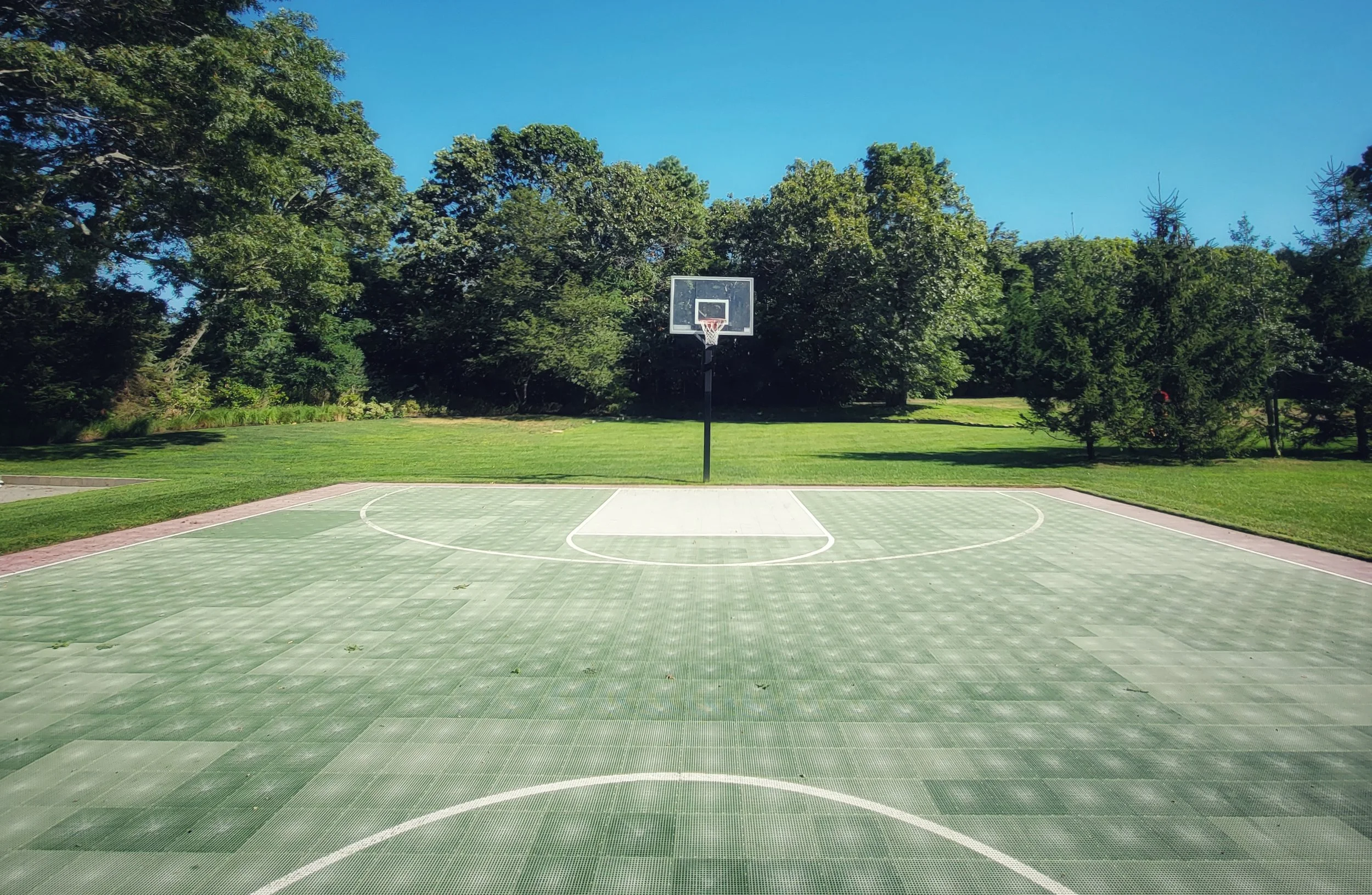
On Long Island properties, a court can be built for basketball, pickleball, bocce, volleyball, or a putting green, and many homeowners combine several of these into one surface. Our custom sports court service starts by asking which games the household actually plays and how often, because that answer shapes everything after it. The result is a court that fits the way you live outdoors, not a catalog product.
The word custom matters here. Two families on the same street can want very different courts, and a design that ignores that produces a surface nobody quite enjoys. We spend time on how the court will be used, who will use it, and what else the yard has to do. That conversation is where a good court really begins.
Because the court is custom, the design can also plan for the future, such as space to add a second game later or wiring for lights down the road. Building in that flexibility now is far cheaper than retrofitting it. We ask about the next five years, not just the next season. A court designed with room to grow keeps paying off.
How Do You Choose Between a Single-Sport and a Multi-Sport Court?
The first real decision is if the court should serve one game well or several games acceptably, and that trade-off drives the size, the surface, and the striping.
A dedicated basketball court plays differently than a multi-sport court that also holds pickleball and volleyball lines. Families with mixed interests often prefer the flexibility of a multi-sport layout, while a serious player may want a single-sport surface tuned to that game. Looking through past projects helps a homeowner picture how each choice feels once it is built.
Budget and space weigh on this decision too, since a single-sport court can be smaller and simpler while a multi-sport court asks for more room and more planning. Neither choice is automatically right, and the stronger answer depends on the household.
We lay out the trade-offs plainly so the decision is yours to make with full information. A court you chose deliberately is one you will still enjoy in ten years.
What Does Multi-Sport Striping Involve, and What Are the Trade-Offs?
Multi-sport striping lays several sets of court lines on one surface so a single court can switch between games. The benefit is clear: one build, more uses, and a court the whole family can share.
The trade-off is visual complexity, since several colors of lines can crowd the surface and make any one game slightly harder to read. A careful design manages this with deliberate color choices and a layout that keeps the primary game clear while the others sit quietly underneath.
Line color and placement are design decisions, not afterthoughts, and they change how the court reads from the patio and the house. We choose a dominant color for the main game and quieter tones for the secondary lines so the surface stays legible.
Done well, multi-sport striping looks tidy and purposeful rather than busy. Done poorly, it turns a handsome court into a confusing grid.
Which Surface Is Right for Your Custom Court?
Surface choice shapes how the court plays, how it feels underfoot, and how much upkeep it needs over the years.
Acrylic hard-court coatings suit basketball and pickleball, cushioned systems ease the impact on knees and ankles, and modular tiles offer a forgiving, quick-draining option. For putting greens and some play areas, a synthetic turf surface gives a consistent roll and soft footing. We match the surface to the games you named and to how the court sits on the property.
Climate matters as well, since a Long Island court sees hot summers and cold, wet winters that test any surface. A quick-draining system sheds rain and returns the court to play sooner after a storm. We weigh durability, feel, and maintenance together rather than chasing one at the expense of the others. The right surface is the one that suits your games and your patience for upkeep.
A surface can also be refreshed over time, since acrylic coatings are recoated and lines are repainted as they wear. That means a court is not a one-time decision but a surface you maintain and update as needs change. We talk through that upkeep at the design stage so there are no surprises later. Planning for the long life of the surface is part of designing the court.
Where Should a Custom Court Sit on the Property?
Siting a court is as important as building it, because the wrong location turns a great surface into an eyesore or a nuisance. We study sun angle, sightlines from the house, distance from bedrooms, and how the court relates to the pool, the patio, and the planting beds.
On a flat Suffolk lot, drainage and the path of runoff also steer where the court lands. The goal is a court that feels like part of the property rather than a slab parked at the edge of it.
Noise and neighbors are part of siting too, because a court used at night sits differently near a property line than tucked behind the house.
We also think about how the court looks from inside the home, since you will see it far more often than you play on it. A well-sited court reads as a feature from the kitchen window. A poorly sited one becomes the thing you wish you could hide.
How Does Grading, Base, and Drainage Affect a Court on a Flat Lot?
A court is only as good as the ground beneath it, so grading, base, and drainage decide whether the surface stays true for years. On the flat lots common around Holbrook, water has little natural fall, which makes engineered drainage and a properly compacted base essential.
Our masonry and hardscape crews build the sub-base and the edges so the court does not heave, crack, or hold water. Getting this hidden work right is what separates a court that lasts from one that fails after a few seasons.
Edges and transitions deserve the same attention as the field of the court, since that is where cracking and settling usually start. We detail the perimeter, the drainage outlets, and the tie-in to the surrounding grade so water leaves the court cleanly.
This is unglamorous work that rarely shows in a photo, yet it decides whether a court ages well. Spending here saves far more later.
What Fencing, Screening, and Lighting Does a Court Need?
Most courts need containment so balls stay in play, and the fencing can be designed to look intentional rather than industrial. Planted screening softens the enclosure and gives the court privacy from neighbors and the street.
Adding outdoor lighting extends play into the evening and lets the court double as a feature after dark, which is worth planning before the conduit goes in. We design these elements together so the fence, the plantings, and the lights read as one composition.
Fence height and mesh choice depend on the games, since basketball and pickleball send balls at different angles and speeds. Gates, seating, and storage can be worked into the enclosure so the court feels finished rather than fenced off.
Lighting should be aimed and shielded to keep glare off the house and the neighbors. Planned together, these details make the court comfortable to use and easy to live beside.
How Does a Custom Court Fit Into a Whole-Property Design?
A court should be planned as part of the whole property, not added later as an afterthought that fights the existing yard. Our landscape design ties the court into the patios, the shade structures, the plantings, and the circulation so the spaces flow together.
When the court, the seating, and the surrounding beds are drawn at once, the result reads as one considered environment. This whole-property view is the idea behind a backyard built around the way you live.
This is also where a court stops feeling like an add-on and starts feeling like it belonged in the yard all along. Paths, plantings, and grade changes carry the eye toward the court and back to the house so nothing feels stranded. A whole-property plan lets the court share materials and lines with the patios and walls around it. The payoff is a yard that reads as one design instead of a set of separate projects.
Thinking about the whole property early also protects the value of the work, since a court that clashes with the house helps no one. A cohesive plan lets each element support the others, so the court, the patio, and the plantings feel intentional. That is the difference between a yard that grew by accident and one that was designed. It is the standard we hold every project to.
What Permits and Setbacks Apply on Long Island?
Custom courts on Long Island often touch local zoning, setback, and drainage rules, and court lighting can carry its own requirements.
Working these out early prevents a redesign after the plan is drawn, and it keeps the project on schedule. We handle the review process as part of the job, so homeowners are not left navigating the town on their own. Planning around the rules from the start is far easier than fixing a court that ran afoul of them.
Every town on Long Island handles these rules a little differently, so local knowledge saves time and avoids costly surprises. We confirm setbacks, drainage requirements, and any lighting limits before the design is finalized, and homeowners in Holbrook get that handled as part of the job.
Sorting it early keeps the project moving and keeps the finished court on the right side of the code. It is one of the quiet advantages of working with a team that builds here regularly.
How Long Does a Custom Sports Court Take to Design and Build?
Timelines depend on the court type, the surface, the site conditions, and any permits, so a real schedule comes from your specific project rather than a generic estimate.
Design and approvals take time up front, and the build itself moves through grading, base, surfacing, striping, and finishing. Our design process walks a homeowner through each phase so the sequence is clear before work begins. Knowing the steps in advance makes the wait feel purposeful rather than uncertain.
Weather and material curing set part of the pace, since surfacing and striping need the right conditions to be done properly. We would rather protect the quality of the finish than rush the last steps to hit an arbitrary date.
A clear schedule set at the start lets the household plan around the work. When the court opens, it opens ready for years of play.
Planning Custom Sports Courts in Holbrook, NY?
If you are considering a court, Gary Duff Designs can design and build custom sports courts that fit your family and your property, sketch through the final line.
Reach out to start the conversation, and we will bring the same design and build team that works across Nassau and Suffolk counties.
In Summary
How much do custom sports courts cost in Holbrook, NY?
Cost depends on the court type, the surface, the site work, and any fencing or lighting, so a real figure comes from your own project rather than a general range that would not reflect your yard.
Can one court really handle several sports?
Yes, a multi-sport court uses layered striping and a suitable surface so a single build can serve basketball, pickleball, and volleyball, with the primary game kept the clearest to read.
Does a putting green count as a custom sports court?
It can be part of one, since many custom courts pair a game surface with a synthetic putting green so the yard covers more than one kind of play in a single design.
How far ahead should I plan a court for next season?
Because design, approvals, and the build each take time, starting a season ahead gives room for permits and weather without rushing the surface work that has to cure and set.
After 4o years, Gary Duff Designs has continued to attain a quality of precision that has differentiated us from other Long Island landscape design & build companies.
Our uniqueness lies in our ability to understand the needs of our clients and offer them creatively distinct environments.
