A backyard putting green installation in Holbrook, NY tends to get discussed as a product with a square footage attached to it, and that is the wrong end of the problem.
What began in 1976 as one man's commitment to quality and honesty has grown into a family legacy. In fifty years of building outdoor spaces on Long Island, the greens that get used are the ones that were placed rather than fitted.
Placement is a design question. Where the green sits determines whether people walk past it on the way to somewhere else, how it reads from the house, what it does to the rest of the yard, and how much of the property it quietly consumes.
Those decisions are made before anyone talks about surface specifications.
Related: Incorporating Game Courts and Putting Greens Into Your Patio Designs in Huntington, NY
Where Does a Putting Green Actually Belong in a Yard?
Somewhere with a reason to walk to it. A green tucked into a far corner because that was the leftover space gets used for a season and then gets mown around. A green that sits on the route between the house and the seating area, or that shares an edge with a terrace where people are already sitting, gets used continuously.
Orientation matters too. Long Island afternoon light is low and long, and a green oriented so that the main putting line looks into the setting sun is uncomfortable for exactly the hours people want to be outside. Turning the same footprint fifteen degrees often solves it.
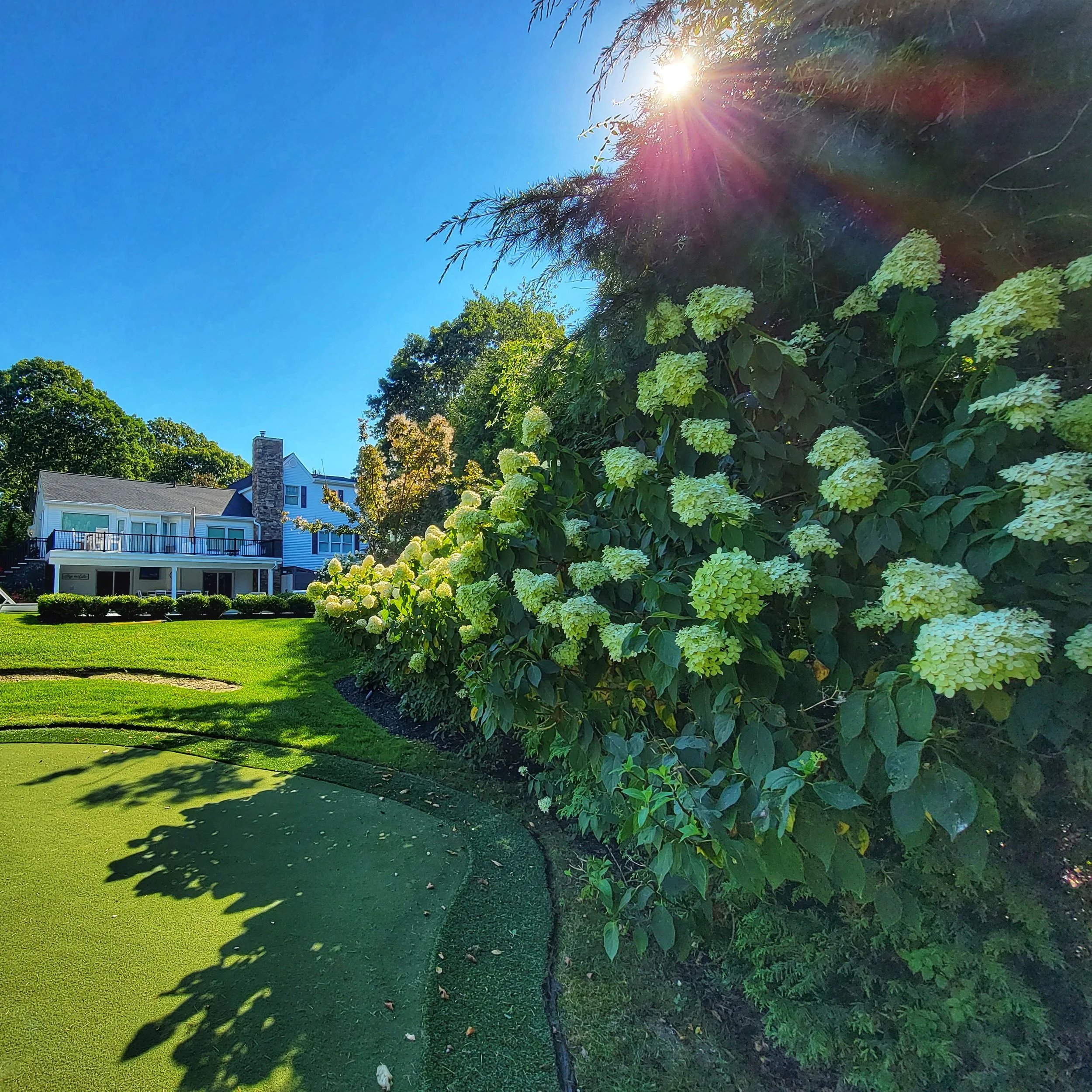
The other consideration is what the green looks like when nobody is on it, which is most of the time. It is a defined shape in the middle of a property, and it either reads as part of the composition or as an object dropped onto the lawn. Our approach to full-property design starts with that question rather than with the feature.
How Much Space Does a Backyard Putting Green Need?
Less than most people assume for something worth having, and more than they assume once the surrounds are counted. The putting surface itself is only part of the footprint. A green needs a fringe around it, room to stand back and address the ball, and space to walk between holes without stepping off the edge every time.
The useful conversation is about what kind of practice the household actually wants. A short-game area for chipping needs a run-up and a landing area, which is a substantially larger commitment than a putting surface alone. A green intended for putting and light chipping fits comfortably into a corner of a mid-sized property.
There is also the question of what the green displaces. Every square foot given to a recreation surface is a square foot not given to lawn, planting or entertaining space, and on a property where those are already tight, the honest answer is sometimes that a smaller green in a better position beats a larger one in a compromised one.
What Does the Ground Underneath Have to Do?
Drain, and hold its shape. A putting surface sits on an engineered base, and the performance of the finished green comes almost entirely from what is under it rather than from the surface itself. Water has to move through the profile and away from the area, because a green that holds water is soft, inconsistent and slow to dry after Long Island rain.
That base also has to resist settlement. Uneven settling shows on a putting surface faster than on any other part of a landscape, because the whole point of the surface is that a ball rolls predictably across it. A dip that would be invisible on a lawn is obvious on a green.
This is the same discipline that goes into terraces and walkways, where a compacted base and a considered drainage path determine whether a surface stays true. Our masonry and hardscape work runs on the same principles.
How Many Holes and What Kind of Contour?
Fewer holes with more variety usually beats more holes on a flat surface. Three or four cups placed so that each one presents a genuinely different putt gives a household more to practice than six cups on a plane. Contour is what creates that difference: a subtle ridge, a fall across the surface, a tier.
Contour has to be designed rather than added. Slope on a putting surface interacts with drainage, with how the green sits against the surrounding grade, and with how the edges are finished. Getting all three to agree is the part that takes drawing.
Restraint helps here. A green with dramatic undulation is entertaining for a month and frustrating afterwards, and it also looks busy in a landscape. The greens that hold up are the ones with enough movement to be interesting and enough calm to sit quietly in the yard.
How Does a Green Sit Alongside the Rest of the Property?
Through its edges, mostly. The transition between a putting surface and whatever it meets is where a green either looks resolved or looks applied.
Meeting a planting bed, a low wall, a stone edge or a change in level all read as deliberate. Meeting a lawn in a straight line rarely does.
Screening is worth considering as well. A green does not need to be hidden, but a run of planting or a structure on one side gives the space some enclosure and stops it reading as a bald patch in the middle of the property.
The wider point is that a recreation surface is one element in a designed yard rather than a self-contained project. Our complete outdoor living approach treats it that way.
What Else Goes Into a Recreation Zone?
Usually more than the green. Households that want somewhere to practice often want somewhere to watch from, which means seating with a view of the surface, some shade over it, and light so the space works in the evening. Those elements turn a practice area into a place people gather.
We design and construct custom courts and entertainment spaces across a range of activities, so a putting green frequently sits alongside a sport court, a bocce or volleyball area, or a multi-sport surface on larger properties. Our gaming and entertainment work covers those configurations.
Shade over the seating rather than over the surface is the usual arrangement, since a green wants sun and the people watching do not. A pergola, pavilion or louvered structure on the viewing side handles that.
How Does Long Island Weather Affect the Surface?
Freeze-thaw is the main consideration, and it works on the base rather than the surface. Water held in the profile expands as it freezes, and a base that drains properly has far less water in it to move. This is another reason the drainage design matters more than any specification of the surface itself.
Leaf load is the second. A green under a mature canopy collects debris every autumn, and organic matter left on the surface holds moisture and stains. Placing a green with the canopy in mind, or accepting that it will need clearing through the fall, is a decision worth making at design rather than discovering in November.
Coastal exposure on the eastern end of the island brings salt and wind into the calculation as well, which affects the planting chosen around the space more than the surface in the middle of it.
When Should the Green Be Designed Relative to Everything Else?
At the same time as everything else, which is the argument for a full-property plan even when only part of it gets built. A green added later to a finished yard has to work around grades that were set without it in mind, drainage that runs somewhere else, and utilities buried under the route the base needs.
Where a property is going to be built in phases, the grading, drainage and any buried services for the recreation area should go in during the first phase. That is a small cost early and a considerable one later.
Lighting follows the same logic. Conduit runs under surfaces, so the fixture positions get located on the drawing even if the lighting is installed in a later phase.
What Does the Design Process Look Like?
Four stages, and the first two are where the placement questions get settled. A consultation and discovery visit reads the property, then a concept and design stage puts the recreation area into a plan alongside the terraces, planting and structures. Refinement and approval follow, and construction and project management come last.
Seeing the whole property drawn is what makes the trade-offs visible. A green in one position takes space from the terrace. In another it blocks a sightline from the kitchen. In a third it works, and the drawing is where that becomes obvious rather than after the base is in.
Our project portfolio shows how recreation surfaces, terraces, kitchens and planting get resolved together on Long Island properties.
Where Does the Kitchen Fit Around a Recreation Area?
Close enough to be convenient and far enough that cooking heat and smoke are not drifting across the seating. On properties where a household entertains around a practice area, an outdoor kitchen tends to anchor one end of the space with the green at the other and the seating between them.
That arrangement also solves the circulation problem. People move between the cooking area and the seating constantly, and running that route along the edge of the green rather than across it keeps traffic off the surface.
How Does a Recreation Area Change Through the Seasons?
It becomes the part of the yard that still works in November. A planted border is dormant and a pool is closed, while a putting surface is usable on any dry day the temperature allows, which extends the months a household spends outside. That is a real argument for the investment on a property that otherwise empties out after September.
Designing for that longer season changes a few decisions. Evergreen structure in the surrounding planting matters more than summer color, because those plants are what the space looks at for half the year. Lighting matters more too, since the usable evening hours in autumn start well before anyone has finished dinner.
Snow is the other end of it. Where the plow or the shovel puts snow from the drive and the walks is worth knowing before a recreation surface is placed downhill of it, since a season of piled snow and the salt in it is hard on planting and on edges.
What Should a Homeowner Bring to the First Conversation?
An honest account of how the household plays. Serious short-game practice and somewhere for guests to putt after dinner are different briefs, and they change the size, the contour and the position substantially. The two produce different yards.
It also helps to know what the property is expected to do otherwise. A household that entertains forty people twice a year needs open space that a household of four does not, and a recreation surface competes for exactly that ground. Saying so early lets the design resolve it rather than discover it.
Design the Yard, Then Place the Green
A putting green is a good addition to a Long Island property and a poor starting point for one. The version that gets used for years is the one whose position, orientation, edges and surrounds were decided as part of the whole design.
Gary Duff Designs designs and builds full-property outdoor spaces, including backyard putting green installation, for homeowners in Holbrook, NY, in Smithtown and across the communities we serve on Long Island.
In Summary
How long does a backyard putting green installation take in Holbrook, NY?
Once the design is settled, the construction itself is a matter of weeks rather than months for a typical residential green. Excavation and base preparation take most of that time. The design stage ahead of it is usually the longer part, and it is where the decisions that matter get made.
Can a putting green be added to a landscape that is already finished?
It can, though the property will constrain the options more than it would have at design stage. Existing grades, drainage runs and buried services all limit where the base can go, and working around them sometimes means accepting a position that would not have been the first choice.
Does a putting green work on a sloped Long Island property?
Slope is workable and frequently makes for a more interesting result, because the design can use the existing fall rather than flattening it. What matters is that the grade change is resolved deliberately, usually with a wall or a terrace, rather than absorbed into the surface itself.
What should be settled before construction begins?
Position, orientation, size, contour, how the edges meet the surrounding landscape, and where water goes. A plan that leaves any of those to be decided on site is not finished, and site decisions made with a machine waiting are rarely the considered ones.